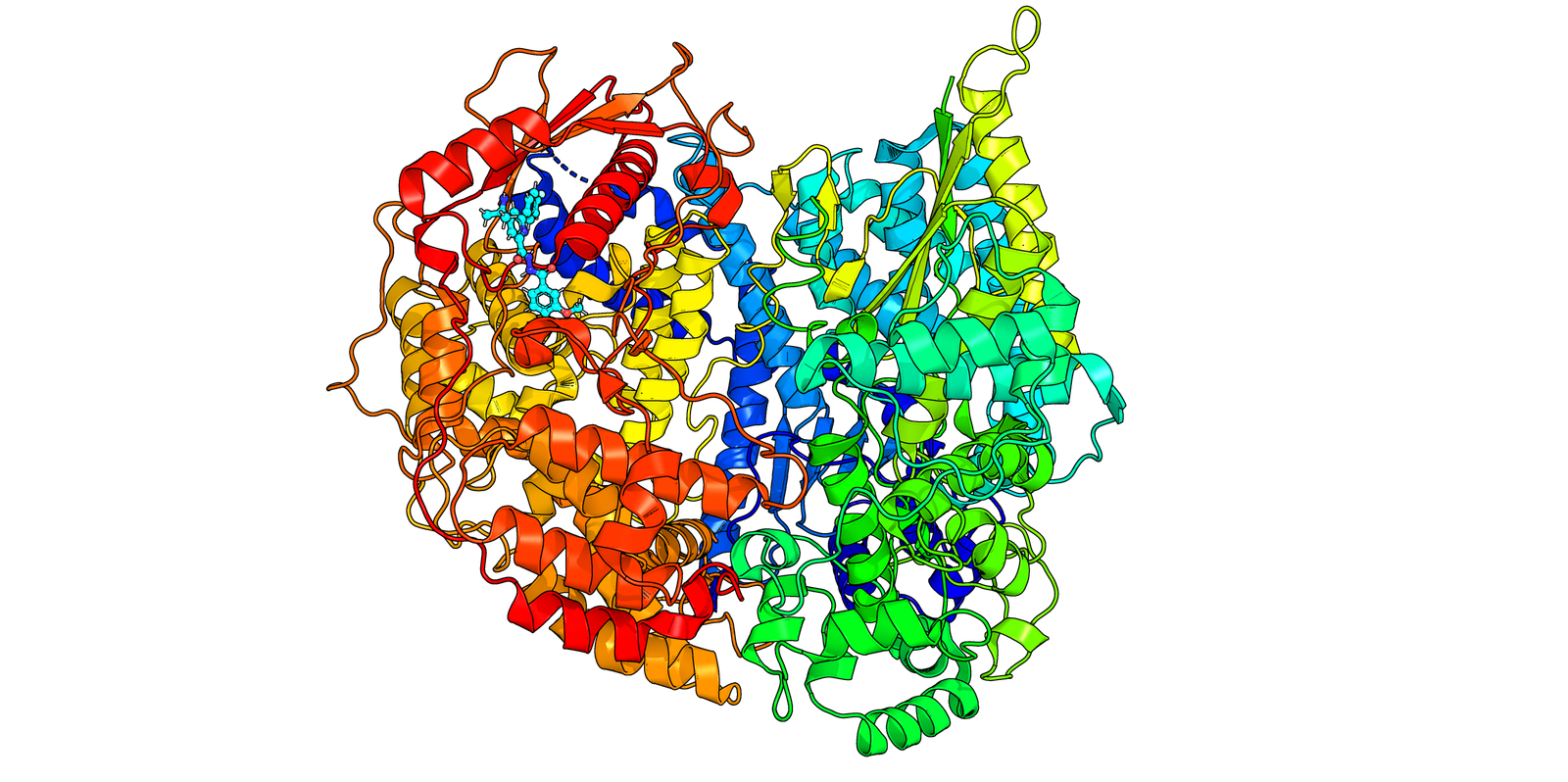
Structure of RdRp from HMPV
3D Structure
| Method | PDB ID | Downloads |
|---|---|---|
| X-ray | 4UCJ | Click here |
| Cryo_EM | 6U5O | Click here |
| X-ray | SFPJ | Click here |
Functional Information
Responsible for RNA synthesis (replicase and transcriptase), cap addition, and cap methylation. Performs also the polyadenylation of subgenomic mRNAs by a stuttering mechanism at a slipery stop site present at the end of viral genes. The template is composed of the viral RNA tightly encapsidated by the nucleoprotein (N). The viral polymerase binds to the genomic RNA at two different sites in the 3' leader promoter thereby initiating either genome replication or mRNA transcription. In the transcription mode, the polymerase performs the sequential transcription of all mRNAs using a termination- reinitiation mechanism responding to gene start and gene end signals. Some polymerase disengage from the template at each gene junction, resulting in a decreasing abundance of transcripts from the 3' to the 5' end of the genome. The first gene is the most transcribed, and the last the least transcribed. Needs as cofactors the phosphoprotein for processivity and the M2-1 anti-termination protein. Polyribonucleotidyl transferase (PRNTase) adds the cap structure when the nascent RNA chain length has reached few nucleotides
Interactions
Interacts with the phosphoprotein (via C-terminus); the association of P and L forms the polymerase complex.
Domains Orgainzation
- RdRp Catalytic Domain = 628-811
- polyribonucleotidyl transferase (PRNTase or capping) domain = 902-137
- methyltransferase (MTase) domain= 1662-1852
Mutation
- D745A = complete loss of polymerase activity.
- G1696A = Impaired cell-cell spread and/or viral replication. Loss of 2'-O methylation activity but not G-N-7 methylation activity.
- G1700A = Impaired cell-cell spread and/or viral replication. 70-80% reduction in N-protein expression. Loss of 2'-O methylation activity but not G-N-7 methylation activity.
- D1755A = Impaired cell-cell spread and/or viral replication. 70-80% reduction in N-protein expression. Loss of 2'-O methylation activity but not G-N-7 methylation activity.